
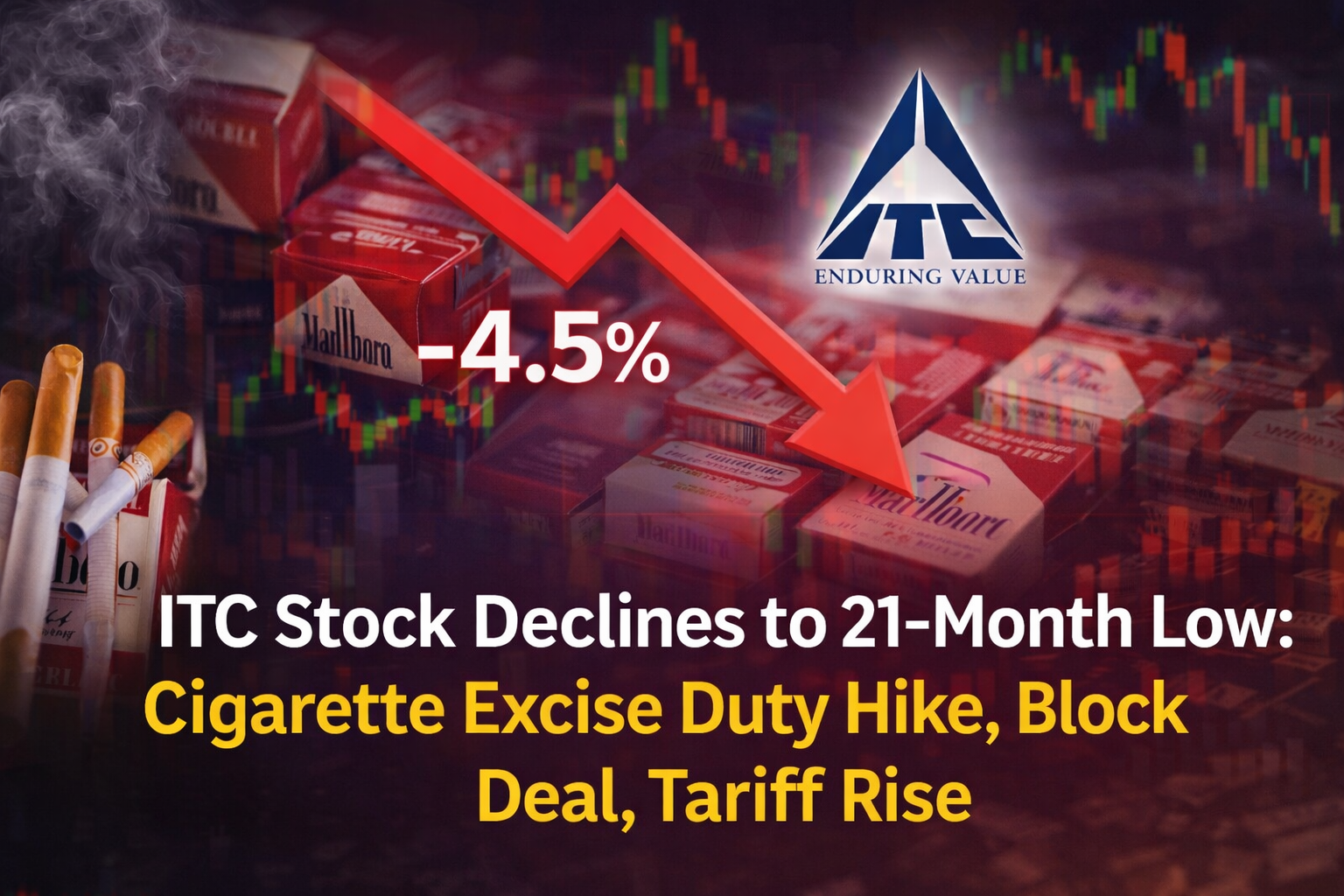
Shares of major tobacco companies witnessed sharp selling pressure on Thursday after the Union Government announced a fresh excise duty structure on cigarettes, triggering concerns over higher taxation and margin pressure across the sector. ITC Ltd, the country’s largest cigarette manufacturer, fell as much as 4.5 percent during the session, while Godfrey Phillips India declined nearly 8 percent, emerging as one of the worst-performing stocks on the market.
The steep fall came after the government approved amendments to the central excise framework for tobacco products, replacing the existing compensation cess with a new, length-based excise duty on cigarettes. The revised tax regime will come into effect from February 1, 2026, and will apply in addition to the existing Goods and Services Tax on cigarettes.
Under the new structure, excise duty will range from ₹2,050 to ₹8,500 per 1,000 sticks, depending on the length of the cigarette. This marks a significant increase in the overall tax burden on cigarette manufacturers, particularly for premium and longer-length cigarette categories. Cigarettes in India already attract a 40 percent GST, making tobacco one of the most heavily taxed consumer products in the country.
Market participants reacted swiftly to the announcement, factoring in potential pressure on profitability and volumes. ITC shares slipped to their lowest levels in several months, dragging the FMCG index lower. Godfrey Phillips, which derives a large portion of its revenue from cigarette sales, saw even steeper losses as investors reassessed earnings visibility under the new tax regime.
Analysts believe the revised excise duty could lead to a sharp increase in production costs, especially for longer cigarette variants. Industry estimates suggest that the new duty could raise costs by over 20 percent for certain product categories. To protect margins, companies may be forced to pass on the increased tax burden to consumers through higher retail prices.
Higher cigarette prices, however, carry the risk of demand moderation, especially in a price-sensitive market like India. While premium cigarette buyers may absorb some of the price increase, sustained hikes could impact volumes over time. This uncertainty weighed heavily on investor sentiment, leading to broad-based selling in tobacco stocks.
Despite the sell-off, some market observers noted that the new excise framework brings greater clarity and stability to cigarette taxation, replacing temporary cess arrangements with a permanent structure. From a policy perspective, the move aligns with the government’s broader public health objectives while also ensuring a steady revenue stream.
Even after the latest hike, India’s total tax incidence on cigarettes remains below global public health benchmarks, though it is among the highest in emerging markets. The long-term impact on cigarette companies will depend on their ability to manage pricing, control costs, and maintain volumes amid rising regulatory and taxation pressures.
For now, the sharp correction in ITC and Godfrey Phillips reflects near-term uncertainty, with investors closely watching how companies respond to the new tax environment and whether price hikes can offset the impact without hurting demand.

 Stock Emphasis
 Stock Emphasis
 Stock Emphasis
 Stock Emphasis
 Stock Emphasis
 Stock Emphasis
 Stock Emphasis
 Stock Emphasis
 Stock Emphasis
 SEBI Registration Number: INH000020022.